

Concrete slabs fool people because they look dry long before they are dry enough for every flooring product.
That matters in Florida, where slab moisture can remain a real installation issue even in homes that seem stable from the surface. If you are comparing tile and laminate over a concrete slab, moisture vapor emission is not a side note. It is one of the first things that should shape the recommendation.
A slab can release moisture upward long after placement, and moisture can also move from below depending on site conditions and construction details. Industry guidance for flooring over concrete consistently points to testing methods such as ASTM F1869 for moisture vapor emission and ASTM F2170 for internal relative humidity because elevated slab moisture can affect adhesive systems, underlayments, and flooring materials differently.
Why slab moisture changes the conversation
When a slab is too wet, different flooring types fail in different ways.
With laminate, moisture risk is often about swelling, edge damage, joint stress, and problems developing below the surface where the boards lock together. Moisture-sensitive core materials are far less forgiving when the subfloor is feeding moisture upward over time. Water-resistant surface claims do not cancel subfloor moisture requirements.
With tile, the tile body itself is generally more moisture-tolerant, but that does not mean elevated slab moisture is irrelevant. Installation systems can still be affected, particularly depending on substrate prep, crack isolation choices, adhesives, and grout performance. Technical guidance from tile-system manufacturers still treats elevated moisture as a condition that must be understood and managed before installation.
Laminate over concrete needs stricter discipline
Laminate can absolutely go over concrete, but only when the slab passes the manufacturer’s moisture limits and the full installation assembly is correct.
That usually means moisture testing, a suitable underlayment or vapor-control layer where required, a flat slab, perimeter expansion space, and careful attention to transitions and edge conditions. If those steps are skipped, the floor may not fail immediately. Instead, it may show stress later through peaking, gap formation, edge swelling, or unstable joints.
This is where a lot of homeowners get caught. The floor may look perfect at install and then slowly tell a different story.
Tile is often more forgiving but not magic
Tile is usually the safer material choice when a homeowner wants a hard surface over concrete and is concerned about moisture resilience. But safer does not mean immune.
If slab conditions are poor, the assembly can still run into bond problems, movement issues, or grout-related symptoms. Tile installations also need proper substrate prep, crack management where applicable, and movement accommodation. The technical advantage is that tile itself is not relying on a wood-fiber core and click joints the way laminate does.
Comfort and sound still matter
Performance is not the only decision point.
Laminate often feels warmer and softer underfoot than tile, and many homeowners like that in living areas or bedrooms. Tile usually feels harder and cooler, which some homeowners love in warmer climates and others find less comfortable. Acoustics differ too. Laminate systems can sound hollow if the underlayment and slab flatness are not handled correctly, while tile tends to feel more solid but can reflect more sound in open interiors.
So the smart comparison is not only moisture risk. It is moisture risk plus comfort, sound, maintenance, and room use.
The right way to choose
A slab-first buying process is much smarter than a style-first process.
Before recommending tile or laminate over concrete, ask:
Has the slab been moisture tested
Is the concrete flat enough for the product
Is this a kitchen, living room, bedroom, or entry area
How important is softer underfoot comfort
How much moisture exposure will the room see from above
Once those answers are clear, the flooring choice becomes easier and more defensible.
If moisture vapor emission is too high, laminate is generally the more vulnerable option. Tile is usually the more forgiving choice over concrete slabs, but it still needs proper installation planning.
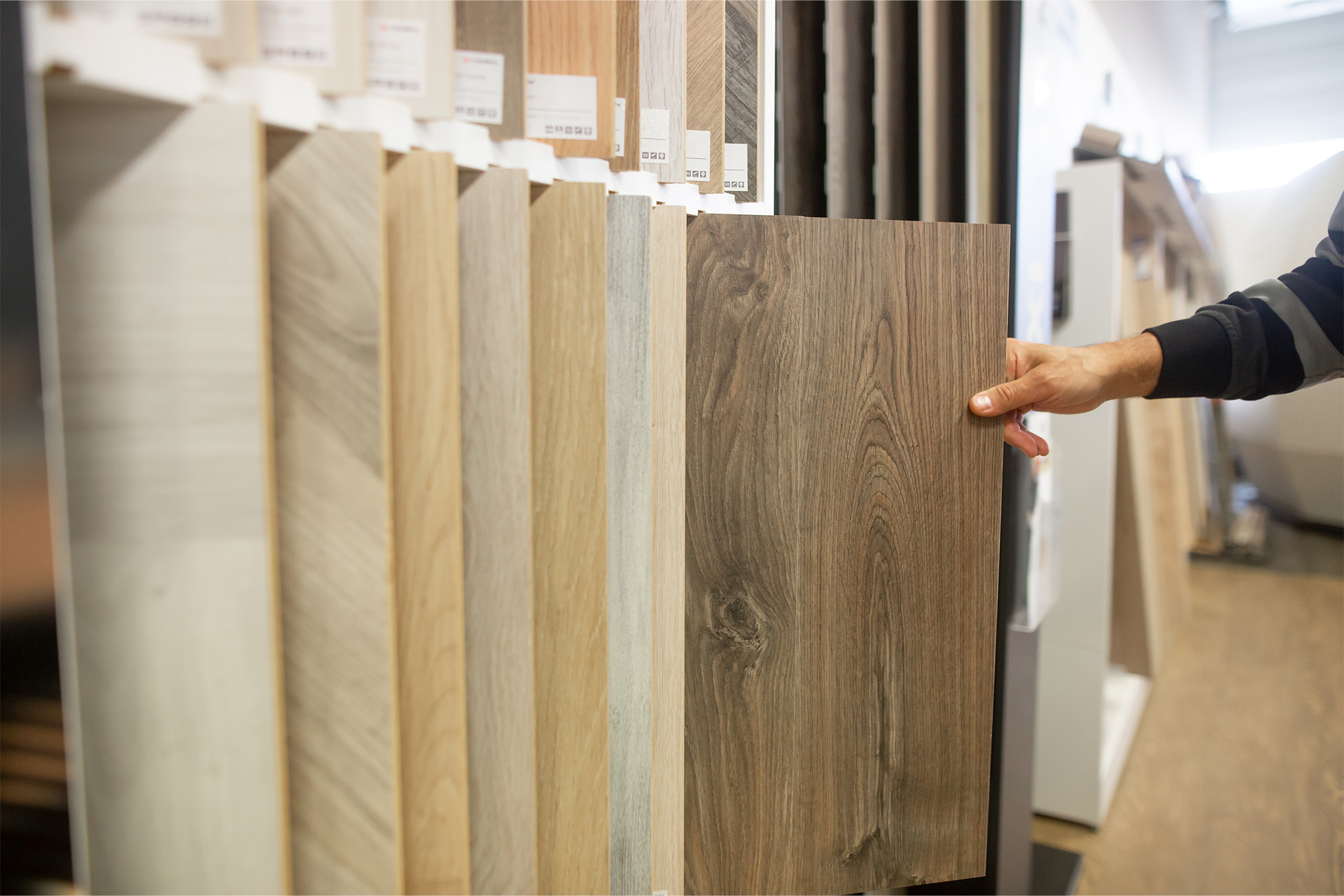
The best floor starts with the slab, not the sample board.
If you are comparing hard-surface options for a concrete-slab home, visit Southern Flooring and Design at Tallahassee, FL. We proudly serve Tallahassee, FL and can help you evaluate product suitability, slab conditions, and room-by-room performance before you buy. Contact us for expert guidance and a flooring recommendation built around how your home actually works.


